

You’ve published the blog post. Shared it on LinkedIn. Maybe paid someone to write it. And six weeks later, it’s sitting on page four of Google — invisible to the people who actually needed to find it.
If that sounds familiar, you’re not alone — and you haven’t done anything wrong. Most business owners know the basics. Good content ranks. SEO matters. But nobody’s actually sat down and explained how — not in a way that’s useful, anyway. Usually it’s either too technical or too vague to act on.
That’s what this piece is for. Not the 200-signals-Google-supposedly-uses trivia. The actual logic — how it works, what genuinely moves the needle, and where most businesses waste time optimizing for things that don’t matter.
What “Ranking” Actually Means, Before the Jargon Takes Over
Strip away the terminology and search engine ranking is a matching exercise. Someone types a question into Google. Google has to figure out, in a fraction of a second, which of the billions of pages it knows about is the best possible answer — then order those answers from most to least useful.
That’s it. That’s the whole job.
Everything else — the algorithms, the ranking factors, the endless debate about what matters in 2026 — exists in service of that one goal: surfacing the most relevant, trustworthy answer first.
Once that clicks, a lot of SEO advice starts making more sense. And a lot of bad SEO advice starts sounding exactly as hollow as it is.
How Does Search Engine Ranking Work? The Pipeline Behind It
Before a page can rank for anything, it has to go through three stages:
Crawling
Google runs automated programs — “crawlers” or “spiders” — that follow links across the web, discovering new and updated pages. If your page isn’t linked from anywhere Google already knows about, it’s much harder to find.
Indexing
Once Google’s crawled a page, it tries to work out what the thing is actually about — the topic, how it’s structured, what entities it mentions — and files that understanding away in its index. Picture a library catalogue the size of the internet, updated constantly.
Ranking
Someone runs a search, and Google pulls the most relevant pages out of that index, then orders them using hundreds of signals — different signals carrying different weight depending on what was actually searched.
Most SEO conversations skip straight to ranking, but crawling and indexing problems are more common — and more damaging — than business owners realize. A page that’s beautifully written but blocked by a stray robots.txt rule, buried three clicks deep with no internal links pointing to it, or duplicated across multiple URLs can struggle to rank at all, regardless of quality. Before you obsess over ranking factors, it’s worth confirming your content is actually being crawled and indexed in the first place — Google Search Console will tell you.
The Search Engine Ranking Factors That Actually Matter
Google’s said, publicly, that its algorithm weighs hundreds of signals. You don’t need to learn all of them — nobody does, not even most SEOs. What you need is the handful that actually do the heavy lifting.
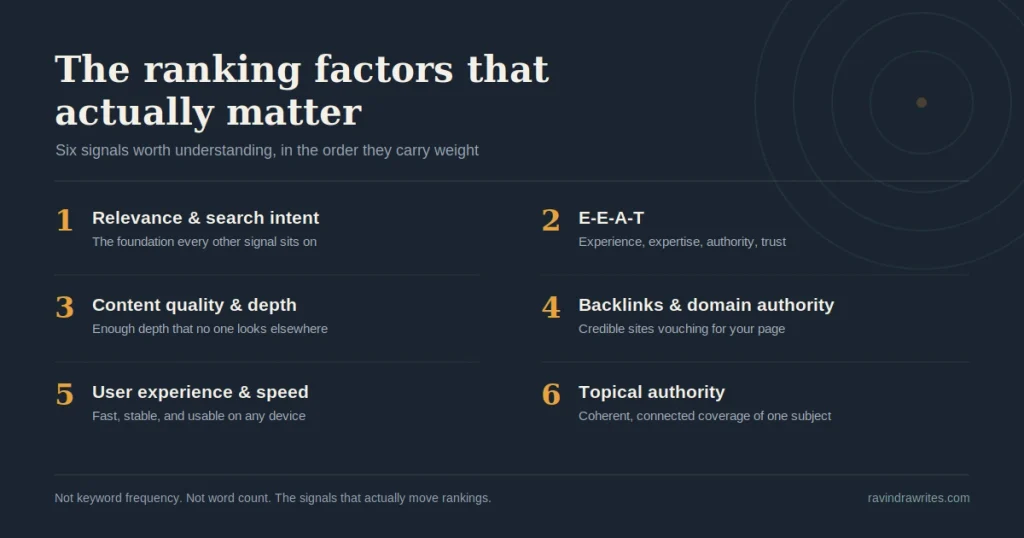
Relevance and search intent
This is the foundation everything else sits on. Google isn’t just matching keywords anymore — it’s trying to match intent. Someone searching “best CRM for small business” wants a comparison. Someone searching “how does a CRM work” wants an explanation. Someone searching “HubSpot pricing” wants, specifically, pricing.
Content that nails the keyword but misses the intent behind it rarely ranks well, no matter how well it’s written. This is the single most common reason business content underperforms — it answers a question nobody was actually asking.
E-E-A-T explained for business owners
You’ve probably seen this acronym thrown around without much explanation. Here’s what it actually means, and why it matters more than most ranking factors combined.
Experience — has the content been produced by someone who has genuinely done the thing they’re writing about? A logistics company writing about customs documentation from lived operational experience reads differently — and ranks differently — than a generic article assembled from other articles.
Expertise — does the content demonstrate real depth? Surface-level coverage that could apply to any business in any industry is a signal of thin expertise, and Google’s systems are increasingly good at detecting it.
Authoritativeness — has your site built a track record on this topic? This is earned over time, through consistent publishing and recognition from others in your field — not something a single article can manufacture.
Trustworthiness — can a reader, and Google, actually rely on what’s here? Named authorship, real citations, transparency about who’s behind the content, accuracy that holds up when someone checks it.
A few practical ways this shows up on the page itself: a visible author bio with real credentials, rather than a generic “admin” byline. Original data, photos, or case studies rather than stock imagery and recycled statistics. Direct links to primary sources when citing a claim, rather than linking to another blog’s summary of that claim.
E-E-A-T doesn’t carry the same weight everywhere, though. For YMYL topics — Your Money or Your Life: health, finance, legal, safety — Google gets a lot stricter, because getting it wrong actually costs people something. If that’s your space, E-E-A-T stops being a nice-to-have. It’s the difference between ranking and not ranking at all.
Content quality and depth
Google wants content that actually resolves the search, so the reader doesn’t need to bounce back and try another result. That means covering a topic with enough depth that someone walks away with a real answer — not padded, not thin, matched to what the query genuinely requires.
This is where the length-obsession that trips up a lot of businesses does real damage. More on that below.
Backlinks and domain authority
When other credible websites link to your content, it functions as a vote of confidence — evidence that your page is worth citing. Not all backlinks are equal. A link from a recognized authority in your industry carries far more weight than a dozen links from unrelated directories or low-quality sites. Quality beats quantity, consistently.
User experience and Core Web Vitals
Page speed, mobile usability, and how stable a page feels while loading all factor into ranking — not because Google cares about technology for its own sake, but because a slow, clunky page is a worse experience for the person Google just sent your way.
Topical authority
This is where the pillar-and-cluster approach earns its keep. A single great article on a subject tells Google you know something. A dozen interconnected, genuinely useful articles covering that subject from every angle tells Google you’re the authority on it. Ranking isn’t just about one page competing with one other page — it’s increasingly about which site demonstrates the deepest, most coherent coverage of a topic.
A note on AI-generated answers
The same principles apply even where Google shows an AI-generated summary instead of a list of blue links. These summaries pull from content that demonstrates the same signals covered above — clear structure, genuine expertise, and content that directly answers the question being asked. There’s no separate playbook for “ranking” in an AI Overview versus ranking traditionally; the content that earns a citation in one tends to be the same content that earns a strong position in the other.
Common Misconceptions About How Google Ranks Content
A few beliefs come up constantly in conversations with business owners — worth correcting directly, because acting on them wastes time and budget.
“If I publish it, Google will rank it.” Publishing gets you indexed, at best. Ranking is competitive — you’re not just being evaluated on your own merits, you’re being measured against everyone else trying to answer the same query.
“Ranking is about hitting the keyword enough times.” Keyword stuffing hasn’t worked in over a decade. Google’s systems understand semantics and related concepts now — writing naturally about a topic, with the language a real expert would use, outperforms mechanically repeating a phrase.
“More content is always better than better content.” A content quality problem gets mistaken for a content quantity problem constantly. Ten thin, mediocre posts rarely outperform two genuinely excellent ones.
“Once it ranks, it stays ranked.” Rankings shift with algorithm updates, competitor activity, and content freshness. Search engine ranking isn’t a one-time achievement — it needs occasional maintenance, especially for time-sensitive or competitive topics.
Does Content Length Affect Search Engine Ranking?
Not directly, no. Length is really just a side effect of covering something properly — it’s not a ranking factor on its own.
Longer content tends to rank well in aggregate studies, but that’s correlation, not causation. Longer articles often rank better because they tend to cover a topic more completely — not because word count itself is a ranking factor. A 900-word article that fully answers a specific, narrow question can outrank a padded 3,000-word competitor that circles the topic without ever landing on the point.
What matters is actually answering the search intent, fully. Sometimes that’s 800 words. Sometimes it’s 3,000. Stretching a piece out to hit some arbitrary word count usually just hurts readability, and it doesn’t do a thing for rankings.
The right question isn’t “how long should this be?” It’s “what does someone need to know to have their question fully answered?” Answer that, and the word count takes care of itself.
How Long Does It Take for Content to Start Ranking?
There’s no fixed timeline, and anyone who gives you an exact number is guessing. That said, a few realistic patterns hold:
- New pages on newer or less-established sites often take three to six months to see meaningful movement, as Google gathers enough signal to judge the content’s quality and relevance.
- Technical fixes — resolving a crawl error, fixing a broken internal link — can show impact faster, sometimes within weeks.
- Competitive keywords with well-established, high-authority pages already ranking will always take longer to break into than long-tail, less-contested queries.
This is precisely why long-tail keywords matter so much for newer sites — not because they’re a lesser strategy, but because they’re where realistic, faster wins actually live.
What This Actually Means for Your Content Strategy
Understanding how search engines rank content isn’t trivia — it should directly shape what you do next.
If relevance and intent matter most, your keyword research needs to go deeper than search volume — you need to understand why someone is searching a term, not just how often.
If E-E-A-T matters, your content needs a real author, real credentials, and genuine first-hand knowledge behind it — not just competent-sounding prose.
If topical authority compounds, a scattered handful of blog posts will always underperform a deliberate pillar-and-cluster structure built around the topics your business actually has authority on.
None of this is complicated in theory. It’s just rarely executed with discipline — which is exactly why the businesses that do it properly tend to pull ahead of the ones publishing content without a strategy behind it.
FAQ: How Search Engines Rank Content
How do search engines decide what content to rank?
They size up a page against hundreds of signals. Is it actually relevant to what someone searched? Is it deep and well put together, or thin and rushed? Does it hold up on E-E-A-T — experience, expertise, authoritativeness, trustworthiness? Do other credible sites link to it? Does it load fast, work properly on a phone? Then Google lines up the results based on how well each one actually gets the searcher to what they came for.
What are the main ranking factors Google uses?
A handful matter more than the rest. How well the content actually matches what someone’s searching for. How deep and well-built it is. E-E-A-T. Whether credible sites link to it. And the technical basics — can Google actually crawl it, index it, does it load fast and work on mobile. Google says hundreds of signals go into ranking overall. These are just the ones doing most of the real work.
Why does some content rank higher even with fewer keywords?
Because Google ranks based on relevance and intent match, not keyword frequency. A shorter page that precisely answers the query — with strong E-E-A-T signals and a good user experience — will often outrank a longer page that’s keyword-dense but doesn’t fully resolve what the searcher needed.
How long does it take for content to start ranking?
Most new content on a developing site takes three to six months to show meaningful ranking movement, though this varies by competition level, site authority, and how well the content matches search intent. Technical fixes can produce faster results than new content creation.
Does content length affect search engine ranking?
Not directly, no. Length is really just a side effect of covering something properly — it’s not a ranking factor on its own. What matters is actually answering the search intent, fully. Sometimes that’s 800 words. Sometimes it’s 3,000. Stretching a piece out to hit some arbitrary word count usually just hurts readability, and it doesn’t do a thing for rankings.
What is E-E-A-T in simple terms?
E-E-A-T stands for Experience, Expertise, Authoritativeness, and Trustworthiness. It’s basically Google’s way of asking: did someone who actually knows this stuff write it, and can readers trust what it says? It matters most for YMYL topics — health, finance, legal — where getting it wrong isn’t just annoying, it can actually hurt someone.
Where This Fits Into Your Broader Strategy
Ranking well isn’t a one-page problem, and it’s not solved by memorizing a list of factors. It’s the outcome of a content strategy built around real search intent, genuine expertise, and a site structure that signals authority rather than scattershot publishing.
If you’re still working out what that looks like for your business, the full picture — keyword research, the pillar-and-cluster model, measuring whether any of it’s actually producing revenue — is covered in the SEO Content Writing for Businesses playbook →
About the Author
Ravindra Raman writes SEO content for a living — has done for 15+ years now, across freight and logistics, Australian healthcare and telehealth, travel and tourism, and digital marketing more broadly. These days he works mostly with businesses in Australia, the UAE, and Sri Lanka.