

Should you hire an SEO content writer or a copywriter? Most business owners don’t think there’s a real difference — not until they’ve paid for one, gotten the other, and wondered why the results fell flat. There is a difference, and it matters. One builds visibility that keeps paying off long after you’ve published it. The other’s built to get someone to act, right now. Mixing the two up isn’t a small mistake. It’s often the reason content budgets go nowhere.
What Is SEO Content Writing?
SEO content writing is content built to rank in search engines while still being genuinely useful to the person reading it. That means keyword research, an understanding of search intent, and on-page structure — headings, internal links, meta data — done properly rather than bolted on afterwards.
Good SEO content answers the exact question your audience is already typing into Google. That’s what earns the ranking. And once it ranks, it keeps bringing in traffic long after you’ve stopped thinking about it — no ongoing ad spend required.
It shows up as:
- Blog articles
- Service pages
- Buying guides and comparison pages
- Location pages
- FAQ and resource pages
A quick example. A plumbing company publishes an article on “Why Your Water Pressure Is Low.” It targets a real search query, pulls in visitors researching the problem, and slowly builds the site’s authority on plumbing topics. That’s SEO content writing at work.
Success here isn’t measured in a single sale. It’s rankings, impressions, click-through rate, and organic sessions — metrics that build gradually, not overnight.
For the fuller picture — strategy, content architecture, keyword research, and ROI measurement — see the complete guide: → SEO Content Writing for Businesses: The Modern Playbook for Driving Organic Revenue
What Is Copywriting?
Copywriting is writing built to get someone to do something — buy, sign up, call, fill out a form. It borrows from direct-response principles and leans on frameworks like AIDA (Attention, Interest, Desire, Action) or PAS (Problem, Agitation, Solution) to get there.
But persuasion alone doesn’t close the deal. The better copy also builds trust along the way — chipping away at objections, laying out real benefits instead of vague claims, speaking to whatever’s actually bothering the reader, and pushing urgency without tipping into the kind of pressure that makes a brand sound desperate.
It shows up as:
- Landing pages
- Email campaigns
- Ad copy (Google Ads, Meta Ads)
- Sales pages
- Product descriptions
Same industry, different job. A landing page encouraging visitors to book an emergency plumbing service is copywriting. It doesn’t need to rank in Google — it needs to convert the person who’s already there, usually arriving through a paid ad or a referral link.
Copywriting is judged on conversion rate, not search rank. A page can convert brilliantly without ranking for a single keyword, because it’s often riding on paid traffic or an existing audience rather than organic search.
SEO Content Writing vs Copywriting at a Glance
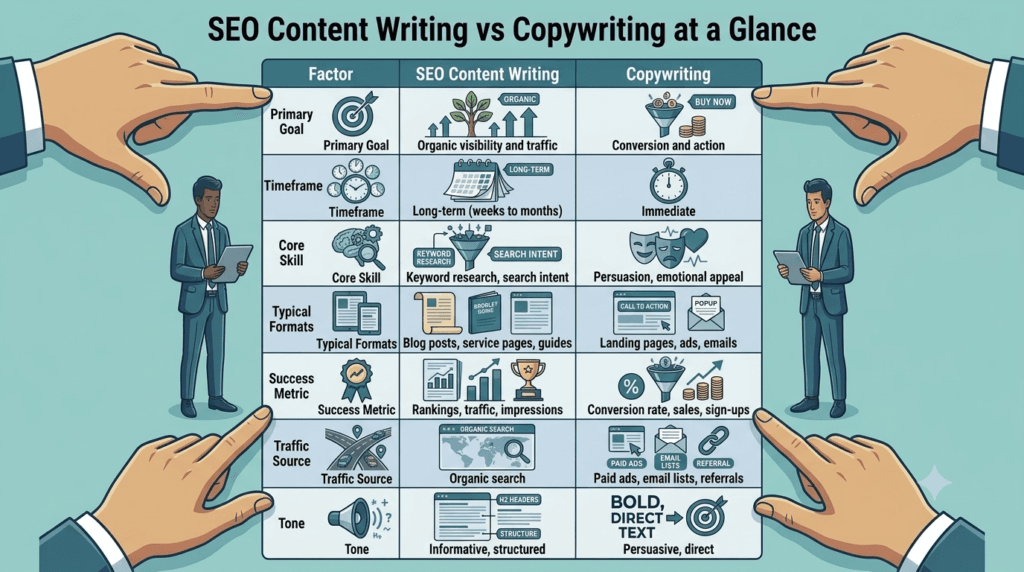
Side by side, the differences are pretty stark. Here’s the whole comparison in one place:
| Primary goal | Organic visibility and traffic | Conversion and action |
|---|---|---|
| Timeframe | Long-term (weeks to months) | Immediate |
| Core skill | Keyword research, search intent | Persuasion, emotional appeal |
| Typical formats | Blog posts, service pages, guides | Landing pages, ads, emails |
| Success metric | Rankings, traffic, impressions | Conversion rate, sales, sign-ups |
| Traffic source | Organic search | Paid ads, email lists, referrals |
| Tone | Informative, structured | Persuasive, direct |
Where the Two Overlap
Here’s the thing — most pages don’t get to pick just one job. A service page has to rank, or nobody ever sees it. But once someone’s there, ranking doesn’t matter anymore; now it has to actually get them to reach out. Search intent up top, persuasion by the time you hit the call-to-action. That’s why the best writers for this kind of work don’t specialise in just one side — they know how to shift gears mid-page without the reader noticing the handoff.
This hybrid approach turns up most often on:
- Homepages and service pages
- Product category pages
- Landing pages built for both SEO and paid traffic
Which Do You Need? A Simple Decision Guide
Do you already have consistent traffic — from ads, referrals, or an email list? Yes → Focus on copywriting. Convert the visitors you’re already getting before spending more on acquisition. No → Invest in SEO content writing first. Build the traffic base before you worry about squeezing more conversions out of it.
Are you building a full business website from scratch? Combine both. SEO content writing pulls visitors in through search; copywriting on service and landing pages turns them into enquiries.
Are you running paid campaigns or launching a specific offer? Copywriting is the priority — a landing page or sales page built to convert fast.
Are you trying to build long-term authority in your industry? SEO content writing is the priority — blog content and guides that keep paying off months after publication.
Can SEO Content Writers Do Copywriting?
Plenty of experienced SEO content writers understand copywriting principles too. Some professionals stay in one lane deliberately — but others produce content that ranks and persuades at the same time. When you’re hiring, it’s more useful to look at a writer’s actual portfolio and results than to fixate on the job title on their profile. Titles don’t always reflect the range of what someone can actually do.
Common Misconceptions
“SEO content is just keyword stuffing.” That one’s outdated. Done right, SEO content writing starts with what the reader actually needs, not with how many times a keyword can be crammed onto a page. Google’s own guidance backs this up — write for people first, not for an algorithm you’re trying to trick.
“Copywriting doesn’t need to think about SEO.” Even landing pages that get some organic traffic benefit from basic on-page SEO — conversion can stay the priority without ignoring search altogether.
“One writer can’t do both well.” Some writers specialise in one discipline and that’s fine. But plenty of experienced content writers, especially those working across service-based industries, build both skill sets — because most business websites need both anyway.
FAQ
What is the difference between SEO content writing and copywriting?
SEO content writing pulls in organic traffic through keyword research and search intent — it’s a long game, measured in rankings and traffic over time. Copywriting’s after something more immediate: getting the reader to actually do something, whether that’s buying or signing up. Judged on conversion, not rankings.
When should you use SEO content writing vs copywriting?
Use SEO content writing to build organic visibility over time — blog posts, guides, informational pages. Use copywriting when you need immediate action — a paid landing page, an email campaign, a sales page. A lot of pages end up needing both: SEO to bring visitors in, copywriting to convert them once they land.
Do I need an SEO writer or a copywriter?
Depends on your traffic source and your goal. Relying on organic search and want to grow visibility over months? An SEO writer’s the right fit. Running paid ads or need a page to convert an audience you already have? Go with a copywriter. Businesses building a full website usually need both eventually.
Is an SEO content writer or copywriter better for a business website?
Most business websites need both. Service pages and homepages typically need SEO content writing to rank, paired with copywriting near the call-to-action to actually convert the traffic once it arrives. A writer who’s skilled in both can often handle this within a single page, rather than you needing two separate specialists.
Should a small business choose copywriting or SEO content writing?
Small businesses on tight budgets tend to get more long-term value from SEO content writing — it builds traffic that keeps working without ongoing ad spend. Copywriting delivers faster results, but it usually needs a traffic source to work with — paid ads, an email list, existing visitors. If you’re just starting out with little traffic, SEO content first tends to pay off more, with copywriting layered in as that traffic grows.
Final Thoughts
Think of SEO content writing as the engine that brings people to your website, and copywriting as the salesperson that turns those visitors into customers. Invest in one without the other, and you’ll limit your own results. The websites that perform best combine both — SEO content writing to attract the right traffic, copywriting to turn it into enquiries or sales.
With 15+ years of experience across freight and logistics, Australian telehealth,digital marketing, and Sri Lanka travel, Ravindra helps brands build a content presence that earns trust, ranks consistently, and turns the right readers into clients.