

Sit in on enough board meetings and you’ll hear it: “We need a content strategy.” Heads nod around the table. Ask anyone to define it afterward, and the room goes quiet.
Let’s fix that.
Content Strategy, Defined
Ask five people at your company what a content strategy is, and you’ll probably get five different answers. Half of them will point to a spreadsheet of blog ideas. That spreadsheet is not a strategy.
A content strategy is the reasoning behind everything you publish — what you make, why you’re making it, who it’s actually for, and what it’s supposed to do for the business. Take away the reasoning, and you’re left with a posting schedule. Useful for a calendar app. Not much else.
Why Business Leaders Should Care
You didn’t get to where you are by guessing. So why let your content run on guesswork?
A real content strategy for business gives you three things most companies are missing:
Direction. Every piece of content earns its place because it serves a purpose — awareness, trust, conversion. Nothing gets published just to fill a calendar.
Consistency. Your voice, your message, your positioning — all of it stays coherent whether a customer reads your homepage, your blog, or your latest LinkedIn post.
Measurable return. You can tie content back to pipeline, not just page views. That’s the difference between a marketing expense and a marketing investment.
If you’re signing off on the budget, that last point should matter most. Content without strategy is a cost center. Content with strategy is an asset.
Content Strategy vs. Content Marketing — What’s the Difference?
This trips people up constantly, so let’s settle it.
- Content strategy is the “why” and the “what.” It’s your research, your audience insight, your editorial priorities, your governance rules.
- Content marketing is the “how.” It’s the execution — the blog posts, the videos, the email sequences that bring the strategy to life.
You can’t have good content marketing without a strategy behind it. You can have a strategy that never gets executed well. Both halves need to work.
Strong SEO content writing for businesses is what turns a strategy document into content that actually ranks, converts, and holds up over time.
How to Create a Content Strategy: The Framework
Here’s a straightforward path, whether you’re building this in-house or briefing an agency.
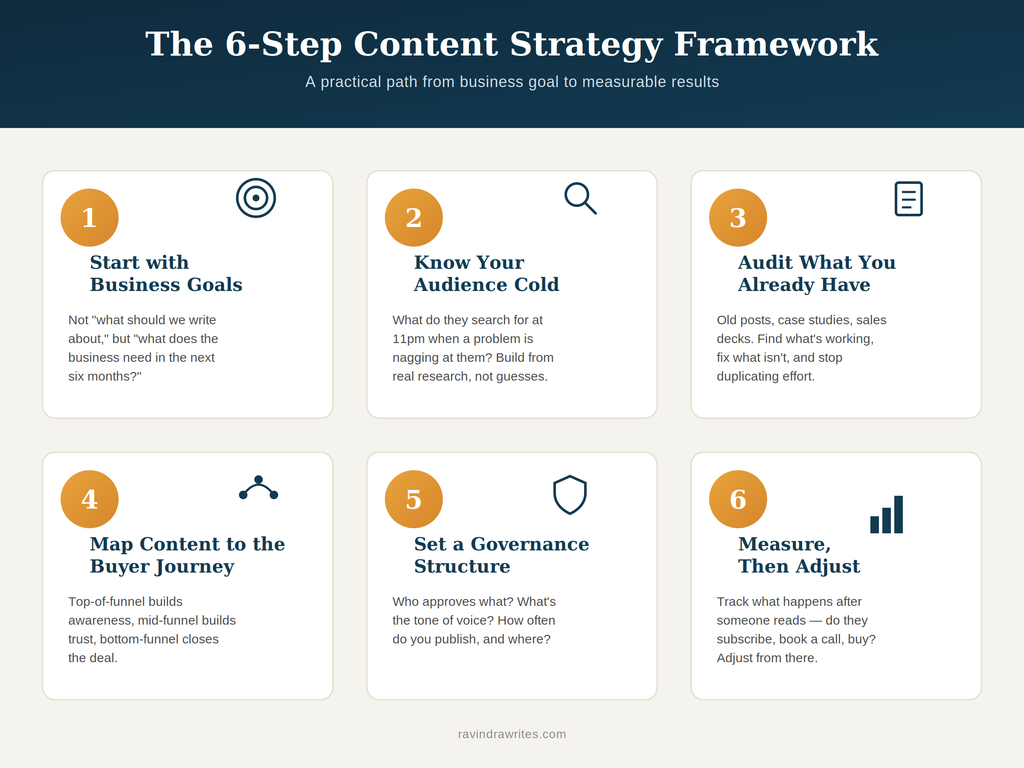
1. Start with business goals, not content ideas.
Don’t ask “what should we write about?” Ask “what does the business need in the next six months?” More qualified leads? Better retention? Authority in a new market? Your content strategy framework should trace back to answers like these.
2. Know your audience cold.
Who are you actually writing for? What do they search for at 11pm when they can’t sleep and a problem is nagging at them? A content strategy without real audience research is just a wish list.
3. Audit what you already have.
Most businesses sit on more content than they realize — old blog posts, case studies, sales decks. Find what’s working, fix what isn’t, and stop duplicating effort.
4. Map content to the buyer journey.
Different content does different jobs. Top-of-funnel content builds awareness. Middle-of-funnel content builds trust. Bottom-of-funnel content closes the deal. A strategy assigns the right content to the right stage.
5. Set a governance structure.
Who approves what? What’s your tone of voice? How often do you publish, and on which channels? Without this, your strategy collapses the moment more than one person is involved.
6. Measure, then adjust.
Traffic is a vanity metric on its own. Track what happens after someone reads your content — do they subscribe, book a call, buy? Adjust based on what the data tells you, not what you assumed going in.
What a Content Strategy Actually Looks Like in Practice
Take two companies selling the same product. Company A publishes a blog post every week because someone told them “consistency matters.” Company B publishes half as often — but every post targets a specific stage of the buyer journey, answers a real question their sales team hears constantly, and links back to a clear next step.
Guess which company’s marketing team gets invited to the revenue conversation.
That’s the practical difference a content strategy makes. It’s not about publishing more. It’s about publishing on purpose.
Common Mistakes Business Leaders Make Here
A few patterns show up again and again:
- Treating content strategy as a one-time document. It’s not. It’s a living plan that should shift as your business, market, and audience shift.
- Confusing activity with progress. Ten blog posts a month means nothing if none of them are built around a strategic goal.
- Leaving SEO as an afterthought. Great content nobody can find is a wasted investment. Strategy and search visibility need to be planned together, not bolted on later.
- No one owns it. If content strategy doesn’t have a clear owner, it drifts. Someone needs to hold the plan accountable.
The Bottom Line
Most businesses already have too much content and not enough strategy behind it. That’s the real problem — not a shortage of blog posts, but a shortage of reasons for those blog posts to exist.
A content strategy fixes that. Before you sign off on next quarter’s content budget, ask your team one question: what is each piece supposed to do? If nobody has a clean answer, you’re not funding marketing. You’re funding output.
Fix the plan first. Everything you publish after that will pull its weight.