

There’s a version of this question that gets answered the same way, on roughly ten thousand websites, every single day. “SEO content writing is the process of creating content that’s optimised for search engines.” Full stop. Maybe a bullet list follows. Maybe a stock image of someone at a laptop.
That definition isn’t wrong. It’s just incomplete in a way that actually matters.
Because if you walk away thinking SEO content writing is about sprinkling keywords into articles and hitting a word count, you’ll spend real money on content that goes nowhere. Seen it happen more times than I can count — businesses with decent websites, interesting services, and genuinely useful things to say, producing content that Google ignores because the strategy behind it was either missing or misunderstood.
So let’s go a bit deeper than the standard definition. (If you’re already past this and want the full picture — strategy, content architecture, ROI measurement — the complete guide to SEO content writing for businesses covers all of it.)
The Real SEO Content Writing Definition
SEO content writing is the craft of producing written content that serves two audiences simultaneously — the human reader and the search engine trying to decide whether your page deserves to rank.
The crucial word there is simultaneously. Not “first write for Google, then make it readable.” Not “write for people and hope Google figures it out.” Both, at the same time, by design.
What does that look like in practice? A piece of SEO content is built around a specific search query — something your audience is actually typing into Google. It’s structured so a reader can move through it easily. It covers the topic with enough depth that the reader doesn’t need to go back to the search results to find something you missed. And it signals to search engines, through its structure, its language, and its links, that it deserves to rank for that query.
That’s the SEO content writing meaning in full. Not a keyword-stuffing exercise. A genuine attempt to be the most useful result for a specific search.
What Is SEO Writing vs Regular Content Writing?
The simplest way to understand the difference: regular content writing is for an audience you already have. SEO writing is how you find the audience you don’t have yet.
That one shift changes a surprising amount about how the work gets done.
When you’re writing regular content — thought leadership, brand storytelling, an internal newsletter — you pick the topic. You write what feels relevant, what your existing readers care about, what your business wants to say. With SEO content, that decision gets made for you. Not by a client or a brief, but by data. Keyword research shows you what people are already typing into Google — how many of them, how often, how stiff the competition is. Your job isn’t to choose a topic. It’s to answer an existing question better than anyone currently does.
The structure changes too. SEO content follows certain conventions — clear headings, a single defined focus, a logical flow that works whether someone reads every word or skims for the bit they need. That’s not a creative constraint so much as a functional one. The framework exists because it helps search engines understand the page, and helps readers move through it. You’ve still got room to write well. You’re just doing it within a shape that serves a purpose.
What Does an SEO Content Writer Actually Do?
More than write, which surprises some people.
A capable SEO content writer starts with research — understanding the keyword landscape, the search intent behind a term, what’s already ranking and why. They look at what topics a piece needs to cover, not just to satisfy a brief, but to satisfy the reader completely enough that they don’t click back to Google looking for something better.
They structure the piece deliberately. Where does the primary keyword sit? What subheadings make sense for the way people scan web content? Is this the kind of query that tends to produce a featured snippet? If so, is there a short, clear, directly answerable paragraph that Google can pull?
They also think about internal links — how does this piece connect to other content on the same website? What’s the logical next step for the reader? Does the page have a clear call to action, or does it just… end?
And then, yes, they write. Well.
The writing part. It sounds obvious, but it’s the piece most businesses quietly underinvest in. You can do everything else right — solid keyword research, clean structure, proper intent alignment — and still end up with a page that sits on page four and stays there. Because the content reads like it was put together, not written. Readers feel that difference within seconds, even if they can’t articulate why. And increasingly, so does Google.
Google’s E-E-A-T framework — which evaluates content on Experience, Expertise, Authoritativeness, and Trustworthiness — is designed precisely to separate content that demonstrates real knowledge from content that mimics it.
How Is SEO Content Different From Blogging?
People use “blogging” and “SEO content” interchangeably, but they’re not the same thing — not exactly.
Traditional blogging is personal and publication-driven. You write about what you find interesting, when you feel like writing it, and publish to an existing readership. The format evolved from online journals. The voice is often conversational, the topics self-selected, the publishing schedule organic.
SEO content is more deliberate. Every topic is chosen because there’s evidence people are searching for it. The structure serves both the reader and the algorithm. Publishing decisions are made strategically, not spontaneously.
That said, the best SEO content has a lot of the qualities that make good blogging work — genuine voice, real perspective, intellectual honesty about what’s complicated. The mechanics differ. The underlying quality standards don’t.
What Makes Content SEO-Friendly?
A few things, and they’re all interconnected.
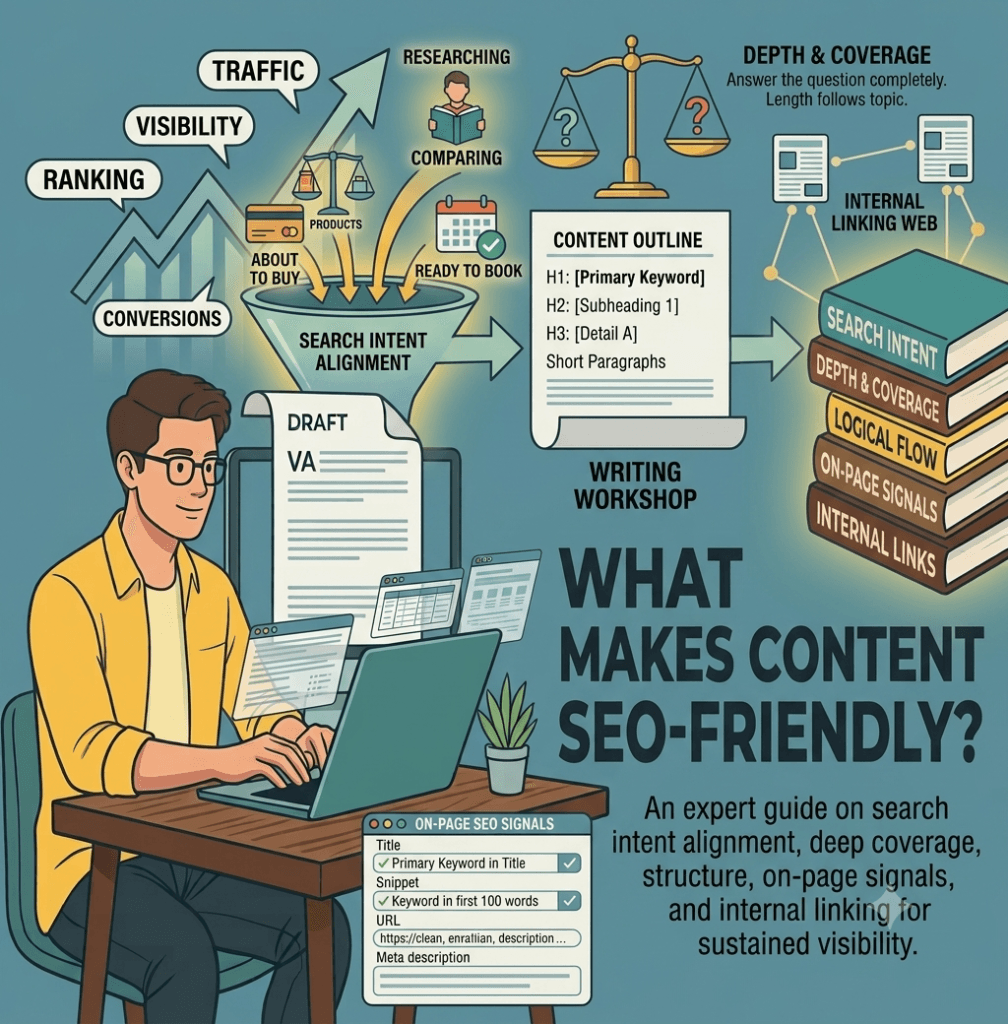
Search intent alignment:
This is probably the most important. Before a word gets written, you need to understand what the person searching for your target keyword is actually trying to do. Are they researching? Comparing? About to buy something? Ready to book? The structure and depth of your content should match that intent — not just include the right keywords.
Depth and coverage:
Google doesn’t reward long content for the sake of it. What it rewards is content that answers the question completely enough that the reader doesn’t need to look elsewhere. Sometimes that’s 800 words. Sometimes it’s 3,000. The length follows the topic.
Structure:
Headings. Short paragraphs. A logical flow that works whether someone reads every word or skims to find what they need. Web readers scan before they commit, and SEO-friendly content is built with that reality in mind.
On-page SEO signals:
The primary keyword in the title, in the first 100–200 words of body copy, in at least one subheading. A meta description that gives a genuine preview of the page. A URL slug that’s clean and descriptive. These aren’t tricks — they’re signals that tell search engines what the page is actually about.
Internal links:
Every piece of SEO content should connect to other relevant pages on your site. This keeps readers engaged, spreads authority across your content, and helps search engines understand the broader structure of what you’re publishing.
Why SEO Content Writing Matters for Businesses
The case for investing in SEO content is straightforward, though it’s often undersold.
Organic traffic is the only kind of traffic that compounds. Pay for an ad, and your traffic exists as long as your budget does. Publish a well-researched piece of SEO content that ranks for a term your audience is searching for, and that page can generate qualified visitors every month for years — without ongoing spend.
More importantly, the intent behind organic search traffic tends to be strong. Someone who finds your business by searching “freight forwarder from Dubai to Melbourne” or “telehealth dermatology consultation Australia” isn’t browsing randomly. They have a specific need. If your content addresses that need and positions your business as the credible, knowledgeable answer — that’s a warm lead, often more qualified than anything paid traffic produces.
Over time, a well-built content strategy also compounds in another way: topical authority. The more genuinely useful content you publish across a topic area, the more search engines recognise your site as a go-to source for it. That recognition translates into rankings that become progressively easier to earn. How that content strategy actually gets built — from keyword research through to content architecture and performance tracking — is a longer conversation, but the foundation is always the same: start with what your audience is searching for, and answer it better than anyone currently does.
Frequently Asked Questions
What is the difference between SEO writing and copywriting?
They’re both writing for business purposes, but they serve different moments in the customer journey. Copywriting is persuasion — it’s your homepage, your product pages, your email sequences. The person reading it already knows you exist. SEO content writing is discovery — it’s how someone who’s never heard of you finds you through a search engine. Blog articles, guides, FAQs, comparison pages — these are the formats that pull in organic traffic. Both matter. They’re just not interchangeable.
Why is SEO content writing important for my business?
Because search is still how most people find solutions to problems, and if your business isn’t appearing in those results, you’re invisible to a significant portion of your potential audience. SEO content builds that visibility — not overnight, but consistently and in a way that paid advertising simply can’t replicate long-term.
How does SEO content writing work?
It starts with keyword research — identifying what your audience is searching for, what intent sits behind those searches, and where you have a realistic chance of ranking. From there, individual pieces of content are built around specific keywords, structured for search intent, written with genuine depth, and connected to the rest of your site through internal links. Performance gets tracked. Content gets updated. Over time, the whole thing compounds.
Is SEO content writing the same as blogging?
Not exactly. Blogging is publication-driven — you choose topics you find interesting and publish to an existing audience. SEO content writing is search-driven — topics are chosen based on evidence of what people are already searching for, and the content is structured to rank for those searches. Good SEO content often reads like good blogging. But the underlying logic is different.
What is the purpose of SEO content?
In simple terms: to be the most useful result for a specific search query. When your content does that reliably, across a range of relevant terms, the byproduct is organic traffic, brand awareness, and — over time — leads and revenue that you can trace back to specific pages.
How is SEO content different from regular content?
Regular content serves an audience you already have. SEO content builds an audience you don’t have yet, by showing up in search results when people are actively looking for what you offer. The structural demands are also different — SEO content follows conventions around headings, keyword placement, and depth that regular content doesn’t need to worry about.
The Short Version
SEO content writing is the discipline of producing written content that people find useful and that search engines can find, index, and rank. It’s not a technical trick. It’s not about gaming an algorithm. It’s about understanding what your audience is searching for and then doing the work of actually answering it — better than anyone else currently does.
That’s what good SEO content looks like. And when it’s done consistently, it becomes one of the most reliable drivers of organic growth a business can build. For everything that comes next — strategy, structure, keyword research, measuring what’s working — the SEO content writing playbook for businesses is the place to go.
Ravindra Raman is a freelance SEO content writer and strategist with 15+ years of experience across freight and logistics, Australian healthcare and telehealth, travel and tourism, and digital marketing. He works with businesses in Australia, the UAE, and Sri Lanka — ravindrawrites.com