

Most small businesses don’t have a writing problem. They have a guessing problem.
They publish articles on topics that feel relevant — industry news, company updates, a “10 tips” post someone suggested over coffee. The writing is fine. The effort is real. And six months later, almost none of it has been found by anyone.
The reason is simple. Nobody checked whether customers were actually searching for those topics in the first place.
Keyword research for small businesses fixes that. It’s the step that turns content from a hopeful exercise into a deliberate one — and it’s the foundation every other part of SEO content writing for businesses is built on.
This guide walks through how to do keyword research for a small business properly, without an enterprise budget: where to find the questions your customers are asking, how to read the intent behind a search, which free tools are worth your time, and how to turn a keyword list into a content plan you can actually execute.
What Small Business Keyword Research Actually Is
Keyword research for small business is the process of finding the words and phrases your potential customers type into search engines — and deciding which of those you have a realistic chance of ranking for.
That second half matters more for small businesses than anyone else.
A keyword list isn’t useful because it’s long. It’s useful because it’s chosen. Good small business keyword research answers three questions at once:
- What are people searching for? The actual language they use — not the language your industry uses internally.
- Why are they searching? The intent behind the query, which tells you what kind of page will satisfy it.
- Can you compete? Whether your site, at its current level of authority, can realistically reach page one.
What it isn’t is a spreadsheet of high-volume terms you’ll never rank for. Chasing “logistics” or “skin care” as a small business is like opening a corner shop and trying to outsell Amazon on day one. The volume is there. The opportunity usually isn’t.
Start With Your Customers, Not a Tool
Most guides get this backwards. They open with software. Plug in a word, export the results, sort by volume.
Tools are useful — we’ll get to them. But the best keyword ideas usually come from somewhere much closer to home: the conversations you’re already having with customers. And this is where small businesses have a real edge. You’re closer to your customers than any big competitor’s marketing team will ever be.
Before you open any tool, spend an hour going through:
- Enquiry emails and sales calls. What do prospects ask before they buy? Those questions are almost certainly being typed into Google by people who haven’t contacted you yet.
- Repeat questions. If you answer the same question every week, that’s a recurring search.
- Reviews — yours and your competitors’. Customers describe their problems in their own words. That language is gold.
- Forums, Reddit threads and local Facebook groups. This is where people ask the questions they’d never ask a salesperson.
- Whoever answers your phone. They know more about how customers think than most marketing plans do.
A small freight forwarder, for example, might find that clients never ask about “freight forwarding solutions.” They ask how long customs clearance takes, what documents they need, and whether their shipment is insured. Those are the keywords that matter — because that’s how real buyers think.
That’s how to find what customers are searching for — before a tool ever tells you. The tools then help you measure and expand it.
Understand Search Intent Before You Chase Any Keyword
Two keywords can look almost identical and need completely different pages.
Someone searching “what is telehealth” wants an explanation. Someone searching “online dermatologist consultation Australia” wants to book something. Write an educational article for the second query, and it won’t rank — however good it is — because it doesn’t match what the searcher came to do.
Search intent generally falls into four buckets:
Informational — The searcher wants to learn. “How does sea freight work,” “best time to visit Sri Lanka.” These suit guides, explainers and blog posts.
Navigational — They’re looking for a specific brand or page. You’ll rarely target these unless it’s your own name.
Commercial — They’re comparing options before deciding. “Air freight vs sea freight,” “best acne treatment options.” Comparison pages and detailed guides work well here.
Transactional — They’re ready to act. “Get a shipping quote Dubai,” “book Sigiriya tour.” Service pages and landing pages belong here.
The easiest way to check intent? Search the keyword yourself and look at what’s ranking. If the top results are all how-to guides, Google has decided the intent is informational. If they’re all service pages, it’s transactional. Don’t fight what the results page is telling you. Google’s own guidance on creating helpful, people-first content makes the same point: the page has to satisfy what the searcher came for.
The Keyword Research Process: How to Find Topics Your Customers Are Searching For
Once you have a list of customer questions and a working grasp of intent, here’s the process I use with small business clients.
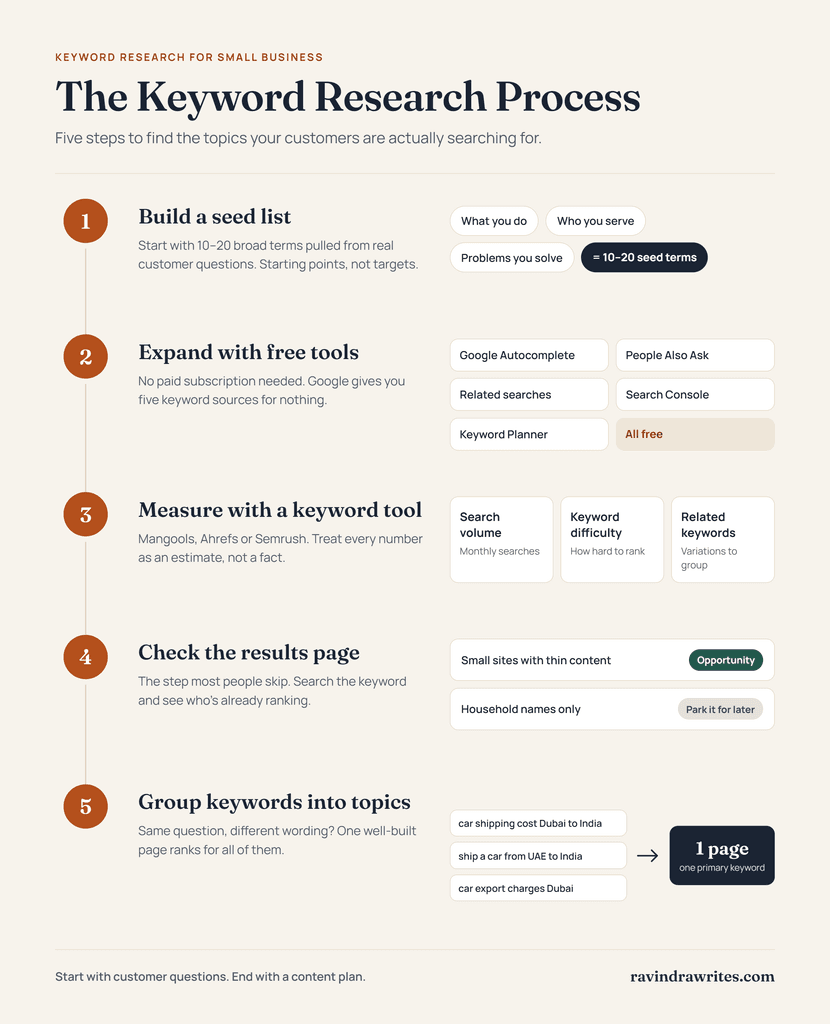
Step 1: Build a seed list
If you’re working out how to find keywords for your business, start with 10–20 broad terms that describe what you do, who you serve and the problems you solve. Pull them from your customer research. These aren’t target keywords yet — just starting points.
Step 2: Expand with free keyword research tools
You don’t need a paid subscription to get started. Some of the most useful free keyword research tools for small business come straight from Google:
- Google Autocomplete. Type a seed term and note the suggestions. Add letters after your term (“car shipping to a…”, “car shipping to b…”) to surface more.
- People Also Ask. Those expandable questions show what searchers want to know next.
- Related searches. The list at the bottom of the results page often reveals angles you hadn’t considered.
- Google Search Console. If your site already gets some traffic, this is the most underused source there is. Keyword research using Google Search Console shows the exact queries you’re already appearing for — including ones you never deliberately targeted.
- Google Keyword Planner. It’s free inside Google Ads. You’ll need an account, but you don’t have to run any ads. It suggests related keywords and gives search volume estimates. Without an active ad campaign, volumes show as broad ranges (such as 1K–10K) rather than exact numbers. One thing to watch: its “competition” column measures how many advertisers are bidding, not how hard it is to rank organically. The suggested bid prices are still useful, though. A keyword that advertisers pay a lot for usually has strong buying intent behind it.
Step 3: Measure with a keyword tool
When you’re ready, bring in a proper tool. I use Mangools (KWFinder and SERPChecker) for most client work. It’s affordable and straightforward, which suits small businesses well. Ahrefs and Semrush do the same core job at a higher price. You’re looking at three numbers:
- Search volume — roughly how many people search the term each month.
- Keyword difficulty — how hard it is to rank, usually based on the strength of the pages already in the top ten.
- Related keywords — variations and longer phrases you can group together.
Treat them all as estimates, not facts. Volume figures can be well off, especially for niche or B2B terms.
Step 4: Check the results page yourself
When it comes to how to choose keywords for a small business website, this is the step that matters most — and the one people skip.
For every keyword you’re seriously considering, look at who’s ranking. National publishers? Government sites? Or other small businesses with sites much like yours? If a small competitor with thin content sits at position three, that’s an opportunity. If the whole first page is household names, park it for later.
Step 5: Group keywords into topics
Here’s what separates modern keyword research from the old-school version: you’re not building one page per keyword any more.
Google understands that “car shipping cost Dubai to India,” “how much to ship a car from UAE to India” and “car export charges Dubai” are essentially the same question. One well-built page can rank for all of them.
Group related keywords into topic clusters. Each cluster becomes one page, targeting one primary keyword and picking up the variations naturally. That’s how the pillar-and-cluster model works — and it stops three of your own pages competing against each other for the same search.
Don’t Skip Local Keyword Research
If your customers are in a particular city or region, local keyword research is where some of your easiest wins are.
Local searches usually carry strong buying intent. Someone searching “physiotherapist Negombo” or “car shipping company Dubai” isn’t browsing. They want someone nearby, soon.
A few ways to find local keywords:
- Add your location to your seed terms — city, suburb, region — and run them through Autocomplete and your keyword tool.
- Look for “near me” variations of your core services. You won’t always put “near me” in your copy, but it tells you what demand exists.
- Check the local results. If the Google map pack appears for a keyword, local intent is strong — and your Google Business Profile matters as much as your website.
- Use the names locals actually use. Neighbourhood nicknames and informal area names often have less competition than official ones.
For many small businesses, a handful of well-built local service pages will bring in more enquiries than dozens of generic blog posts.
Why Long-Tail Keywords for Small Business Beat Broad Terms
Long-tail keywords are longer, more specific phrases — usually three words or more — with lower search volume and much clearer intent.
“Dermatologist” is a head term. “Online dermatologist for hormonal acne Melbourne” is long-tail.
The head term gets more searches. It’s also near-impossible to rank for, and most people searching it aren’t ready to act. The long-tail version gets a fraction of the traffic — but the person typing it knows exactly what they want.
For small businesses without years of domain authority, long-tail keywords aren’t a consolation prize. They’re the strategy. They rank faster, attract people with real buying intent, and build the topical authority that eventually lets you compete for broader terms.
Stack enough good long-tail pages together, and the combined traffic often beats a single head-term ranking you’d have spent years chasing.
Search Volume Isn’t the Whole Story
A tool showing “0–10 searches a month” doesn’t always mean nobody’s searching.
Volume estimates come from sampled data, and they’re unreliable for specialised industries. Some of the best-converting pages I’ve written targeted terms the tools said barely existed — because the few people searching them were exactly the right buyers.
There’s another shift worth knowing about. More searches now end with an AI-generated answer, in Google’s AI Overviews or tools like ChatGPT and Perplexity. Specific, question-based content that answers clearly and shows real expertise is more likely to be cited there. So the detailed questions your customers ask are worth even more than their volume suggests.
The rule of thumb: if you hear a question regularly, write about it — whatever the tool says.
Common Keyword Research Mistakes Small Businesses Make
A few patterns come up again and again:
- Targeting only high-volume terms. Big numbers look good in a report. They rarely produce leads for a site that can’t rank for them.
- Using industry jargon. You might call it “last-mile fulfilment.” Your customers call it “home delivery.” Use their words.
- Ignoring intent. A blog post won’t rank for a transactional keyword, and a sales page won’t rank for an informational one.
- One keyword, several pages. Without a clear map, you end up with pages competing against each other and none of them winning.
- Ignoring local searches. Many small businesses chase national keywords while their best customers are searching locally.
- Doing it once. Search behaviour shifts. Revisit your keyword research at least a couple of times a year.
Turning Keyword Research Into a Content Plan
A keyword list in a spreadsheet doesn’t do anything on its own. The value comes when you turn it into a plan.
For each topic cluster, decide:
- The primary keyword the page will target.
- The search intent — and therefore the page type: guide, comparison, service page or landing page.
- Where it fits — a pillar, a supporting cluster, or a standalone page.
- Its priority, based on business value, difficulty and how quickly you could realistically rank.
Then start with pages that combine high business value and achievable difficulty. Those are your early wins — the pages that build momentum while you work towards harder targets. For most small businesses, that means core service pages and local pages first, then supporting guides.
This is the bridge between keyword research and a proper content strategy. One tells you what people are searching for. The other decides what you’ll build, in what order, and why.
Frequently Asked Questions
Can I do keyword research for my small business myself?
Yes. Google Autocomplete, People Also Ask, Search Console and Keyword Planner will take you a long way for free. Where an experienced hand helps is judging difficulty realistically and turning the research into a plan.
How much does keyword research cost for a small business?
It varies widely, from free (if you do it yourself) to a one-off project fee or an ongoing retainer. What matters is whether the research leads to a clear, prioritised content plan — not just a long list.
How many keywords should a small business target?
One primary keyword per page, plus its natural variations. Across your site, start with a focused set of topics tied to your core services, then expand as those pages gain traction.
How often should a small business do keyword research?
Do a full round when you plan your content, then lighter reviews every few months. Search Console will show you new queries as they appear.
Where to Go From Here
Keyword research for small business isn’t glamorous. It doesn’t produce anything you can publish on day one. But it’s the difference between content that quietly builds a pipeline of leads and content that sits unread on page six.
If you’d rather not spend weeks inside keyword tools — or you want a second pair of eyes on whether you’re targeting the right terms — I offer keyword research and content planning for businesses across freight and logistics, healthcare, travel and professional services.
Get in touch for a no-obligation conversation about what your customers are actually searching for.
Ravindra Raman is a freelance SEO content writer and strategist with 15+ years of experience across freight and logistics, Australian healthcare and telehealth, travel and tourism, and digital marketing. He works with businesses in Australia, the UAE, and Sri Lanka.