

There’s a version of SEO content writing that most businesses end up with — and then there’s the version that actually works.
The first version looks fine on paper. Regular blog posts. Keyword-stuffed headings. Articles that hit a word count and call it a day. The second version is different. It’s built around how your customers actually search, what they’re trying to figure out, and where they are in the decision-making process when they land on your page.
This playbook is about the second version.
Whether you’re a business owner trying to make sense of why your content isn’t producing leads, a marketing manager who’s been handed a brief and a keyword list, or a founder who’s decided it’s time to stop paying for ads and start building something that compounds — this guide covers what you need to know.
We’ll go through the full picture: what SEO content writing actually is, how search engines decide what ranks, what a real content strategy looks like, and how to turn all of it into revenue you can trace back to a page.
What Is SEO Content Writing, Really?
Most definitions of SEO content writing stop at “writing that’s optimised for search engines.” That’s technically accurate, but it misses the more important half of the equation.
Good SEO content writing is writing that’s optimised for people — and structured in a way that search engines can understand, index, and reward.
The distinction matters because Google’s job, at its core, is to match searchers with the most genuinely useful result for their query. That means the better your content serves the reader, the more likely it is to rank. The two goals — ranking well and serving your audience — aren’t in conflict. They’re the same goal.
→ What Is SEO Content Writing? (And Why It’s Not the Same as Blogging)
SEO Content Writing vs Copywriting
Why the Difference Matters for Your Business
Business owners often use these terms interchangeably. They shouldn’t.
Copywriting is persuasion.
It’s the words on your homepage, your product pages, your email sequences, your ad headlines. Its primary job is to convert — to take someone who’s already aware of you and move them toward a decision.
SEO content writing is discovery.
It’s how people who’ve never heard of you find their way to your website through search. Blog articles, guides, FAQs, comparison pages — these are the formats that pull in organic traffic at scale.
Both matter. But they serve different moments in the customer journey. Knowing which one you need — and when — saves you money and produces better results.
→ SEO Content Writing vs Copywriting — What’s the Difference and Which Do You Need?
How Search Engines Actually Decide What Ranks
You don’t need to understand every technical signal Google uses to rank content. There are hundreds of them, and they shift constantly. What you do need to understand is the underlying logic — because once you get that, a lot of the rest falls into place.
Google is trying to solve a matching problem. On one side, you have a person with a question or a need. On the other side, you have millions of pages that might answer it. Google’s job is to find the best match — and then rank the results in order of quality, relevance, and trustworthiness.
The signals it uses to do that include:
Relevance
— Does the content actually address what the person searched for? Not just the keywords, but the intent behind the search.
Experience
— Does the content reflect genuine first-hand knowledge of the topic? Google increasingly rewards content written by people who have actually done the thing, not just researched it.
Expertise
— Does the author demonstrate real depth in their subject area? This is particularly important in YMYL (Your Money or Your Life) topics — finance, health, legal — where poor advice carries real consequences.
Authoritativeness
— Does this website have a track record of publishing credible, accurate content on this topic? Authority is built over time through consistent publishing, quality backlinks, and recognition from others in the field.
Trustworthiness
— Are there credentials, citations, clear authorship, and other signals that tell Google — and the reader — that this content can be relied upon?
→ How Search Engines Rank Content — What Every Business Owner Should Know
These five factors form Google’s E-E-A-T framework (Experience, Expertise, Authoritativeness, Trustworthiness). Understanding them helps you see why simply publishing more content isn’t a strategy — and why businesses that treat SEO as a checkbox exercise rarely see results.
The Content Strategy Question That Most Businesses Skip
Here’s what tends to happen when a business decides to “do SEO content.” They pick a few topics that feel relevant. They write some articles. They publish them. Then, three months later, they look at the traffic numbers and wonder why nothing moved.
The missing piece is almost always strategy.
A content strategy isn’t a content calendar. It’s not a list of blog topics. It’s a deliberate plan for building topical authority — establishing your website as the most comprehensive, credible resource in your space — so that search engines recognise your site as the go-to source for the queries your customers are typing.
That plan includes:
- Keyword research — understanding which terms your audience actually uses, how competitive they are, and what intent sits behind them
- Content architecture — deciding how your pages relate to each other and how to build a logical, interconnected topic structure
- A publishing cadence — consistent publishing creates more opportunities to build topical authority, capture search demand, and compound your content’s reach over time
- Performance tracking — knowing which content is working, which isn’t, and why
Keyword Research: The Foundation of Everything
Every piece of content that generates organic traffic starts with keyword research. Not with a great idea, not with a topic brainstorm — with an understanding of what people are already searching for and whether you have a realistic chance of ranking for it.
Done properly, keyword research does several things at once. It tells you what your audience wants to know. It reveals gaps in your current content. It shows you which opportunities are worth pursuing and which ones are so competitive that you’d need years of domain authority to break in.
For newer or less-established websites, the sweet spot is almost always long-tail terms — more specific, lower-volume queries with clearer intent and far less competition. It’s where you can realistically rank, where purchase intent tends to be higher, and where the traffic that converts often hides.
The Pillar-and-Cluster Model
How Serious Businesses Build Content Authority
If you’ve ever wondered why some websites seem to dominate entire topics in search results — not just one or two keywords but dozens of related ones — the pillar-and-cluster content model is usually the answer.
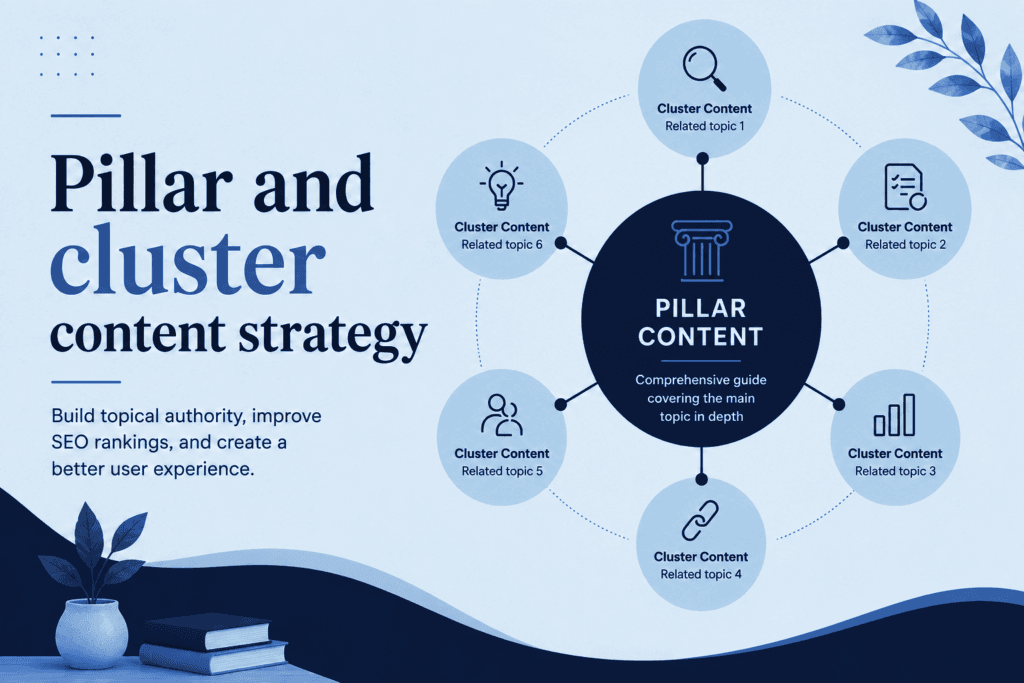
The idea is straightforward. You build a comprehensive, authoritative page on a broad topic (the pillar). Then you create a network of supporting pages (the clusters) that go deeper on specific subtopics — and link back to the pillar. Over time, this interconnected structure signals to Google that your site has genuine expertise across the topic, not just a handful of loosely related posts.
Think of it less like a blog and more like a textbook. Each chapter connects to the others. The whole is greater than the sum of its parts.
For a business selling professional services, software, or complex products, this model is especially powerful. It lets you capture traffic at every stage of the buyer journey — from “what is X” all the way to “hire X for my business.”
How to Write SEO Blog Posts That Actually Rank
Most businesses know they should be writing blog content. Far fewer know what separates the articles that rank from the ones that vanish on page six.
A few things that matter more than most people realise:
Search intent alignment. Before you write a single word, you need to understand what the person searching for your target keyword is actually trying to do. Are they trying to learn something? Compare options? Make a purchase? Your content needs to match that intent — not just include the keyword.
Structure and scannability. Readers don’t read web pages the way they read books. They scan. Clear headings, short paragraphs, and a logical flow that lets someone get the gist before deciding whether to read more deeply — these aren’t nice-to-haves.
Depth and completeness. Pages that satisfy search intent more completely tend to perform better — because users find what they need without bouncing back to the search results. The goal isn’t length — it’s coverage that matches what the searcher actually came to learn.
Internal links. Every piece of content you publish should connect logically to other pages on your site. This keeps readers engaged, distributes authority across your pages, and helps Google understand the structure of your content.
A clear next step. Content that ranks is content that serves. But content that converts is content that guides. Every post should end with a clear invitation — to read more, to get in touch, to download something. Don’t leave the reader stranded.
How Long Should Your Content Be?
The honest answer: as long as it needs to be.
Word count as a proxy for quality is one of the most persistent myths in content marketing, and businesses waste enormous amounts of time and money chasing arbitrary targets.
What actually matters is coverage. If a topic can be fully addressed in 800 words, a 2,500-word article won’t rank better — it’ll just be padded and harder to read. If a topic genuinely requires 3,000 words to do properly, a thin 700-word post will lose to a more comprehensive competitor every time.
The practical approach: look at what’s ranking for your target keyword. What does that content cover? What depth does it go into? Use that as your benchmark, then aim to match or exceed it — on quality, not on word count.
Measuring the ROI of SEO Content
Because Traffic Is Not the Point
Here’s a frustration many business owners share: they invest in SEO content, watch the traffic numbers climb, and still can’t connect those numbers to revenue.
Traffic is a leading indicator. It tells you that your content is reaching people. What it doesn’t tell you, by itself, is whether those people are doing anything useful when they arrive.
Measuring SEO content ROI properly involves tracking the full journey:
Organic sessions → Engaged sessions → Conversions → Qualified leads → Revenue
Not every piece of content is designed to convert directly. A top-of-funnel awareness article will rarely produce an enquiry on the first visit. But it puts your brand in front of someone who might return via a branded search six weeks later and become a client. That’s an assisted conversion — and it counts.
Modern SEO reporting accounts for this full picture: assisted conversions, multi-touch customer journeys, and branded search uplift. Attribution in SEO is messy, and anyone who tells you it’s simple is selling you something.
AI Content Writing vs Human Content Writing
What Businesses Need to Know in 2026
It would be odd to write a pillar page on SEO content writing in 2026 without addressing the question every business owner is asking: can we just use AI?
The honest answer is: it depends on what you’re using it for.
AI writing tools have become genuinely useful for certain tasks — drafting outlines, generating first-pass content on well-documented topics, repurposing existing material, and speeding up research. For businesses producing large volumes of relatively straightforward content, AI-assisted workflows can cut production time significantly.
But there are clear limits, and pretending otherwise doesn’t serve anyone.
Where AI content tends to fall short
AI generates text based on patterns in existing content. That means it can produce plausible-sounding articles on almost any topic — but it can’t contribute genuine experience, original perspective, or industry insight that doesn’t already exist online. In competitive niches, that’s a serious disadvantage.
The E-E-A-T problem: Google’s quality guidelines place increasing weight on Experience — the first E in E-E-A-T. Content that shows genuine first-hand knowledge of a topic is evaluated more favourably than content that aggregates existing information. AI, by definition, can only do the latter.
Where AI genuinely helps
Used well, AI is a production tool, not a replacement for strategic thinking. It can draft, it can structure, it can suggest. An experienced human writer — who understands the topic, knows the audience, and can apply editorial judgement — can then shape that raw material into content that is genuinely useful, credibly sourced, and editorially coherent.
The businesses seeing the best results from content right now are those using AI to accelerate production while keeping a skilled human writer in control of quality, strategy, and voice
The Outsourcing Question
Should You Write Your Own Content or Hire Someone?
For most businesses, the honest answer is: you should probably hire someone.
Not because business owners can’t write — many can, and some write brilliantly. But because SEO content writing is a specific skill set. It requires fluency in keyword strategy, an understanding of search intent, a feel for structure and readability, and enough experience to know when a piece is genuinely good versus when it just looks long enough.
More importantly, it requires time. Consistent time. The compounding effect of SEO content only materialises when you publish regularly over an extended period. For most business owners, maintaining that cadence while running everything else is genuinely difficult.
What Does SEO Content Writing Actually Cost?
Pricing in content writing varies so widely that it can be genuinely confusing — from $5 per article on content mills to $500+ per piece from senior specialists.
The variance exists because quality varies enormously. Budget content tends to be surface-level, formulaic, and heavily AI-assisted — which means it often fails to rank, and when it does, it doesn’t convert. Premium content is built around proper research, genuine expertise, and a strategic understanding of where each piece fits in the broader content architecture.
The business case for investing in quality content is straightforward: a well-researched, well-written article that ranks for a competitive keyword can generate qualified organic traffic every month for years.
The way to think about content is not as an expense but as a long-term asset. Unlike an ad that stops working the moment you stop paying for it, a strong piece of SEO content continues to earn.
How to Hire an SEO Content Writer
And What to Actually Look For
Not all content writers are SEO content writers. And not all SEO content writers are equally capable.
A few things worth knowing before you hire:
Niche experience matters. A writer who has spent years covering your industry will produce better content faster than a generalist who needs to research everything from scratch.
Ask to see results, not just samples. Anyone can show you an article that looks polished. What you want to know is whether their work has actually ranked, driven traffic, or produced leads for the businesses they’ve worked with.
Look for strategic thinking. A good SEO content writer doesn’t just execute briefs. They ask questions about your audience, your goals, your competitive landscape. They push back if a keyword target doesn’t make sense.
Clarity on process. How do they approach keyword research? How do they handle revisions? What’s their workflow from brief to published piece? A professional writer has answers to all of these.
Industry-Specific SEO Content Writing
Generic SEO content writing can get you so far. In regulated, specialised, or high-trust industries, it’s rarely enough.
Freight and Logistics
Freight is a sector where the buying journey is complex and the search terms are often highly specific — route-based, commodity-based, or compliance-based. Content that speaks to the actual concerns of a freight buyer (transit times, customs documentation, Incoterms, liability limits) performs vastly better than content that treats shipping as an abstract topic.
Healthcare and Telehealth
Healthcare content sits within a regulatory framework that most writers don’t understand — and that framework varies significantly by country. In Australia specifically, content must navigate AHPRA’s guidelines on testimonials and therapeutic claims, TGA regulations on how products and treatments can be described, and the careful balance between being genuinely useful to patients and avoiding anything that could constitute medical advice.
Travel and Tourism
Travel content lives or dies on specificity and atmosphere. A generic “Top 10 Things to Do in Sri Lanka” article competes with thousands of similar pieces and rarely ranks for anything useful. Content that goes deep — that treats a destination with the kind of detail that only comes from genuine familiarity — earns rankings, earns links, and earns trust from readers who are making real decisions about where to spend their money and time.
Digital Marketing
There’s an irony in digital marketing content that’s poorly optimised for search — but it’s more common than you’d think. Writing for a digital marketing audience is a different challenge from most niches. The readers know the terminology. They can spot generic takes from a distance. What earns their trust — and earns rankings — is content that goes beyond the basics and demonstrates that the writer has actually worked in the space.
Geographic Reach: SEO Content for Global Markets
Where your clients are located affects both the type of content that works and how it needs to be positioned.
Australian Businesses
Australian businesses operate in a market with specific regulatory, cultural, and competitive dynamics. Healthcare is heavily regulated. Consumer expectations around transparency are high. And the competitive landscape in most industries skews toward local credibility — content that demonstrates genuine familiarity with the Australian context, not just international best practices translated to a local URL.
UAE and Gulf Businesses
The Gulf market presents a different set of considerations — a multilingual audience, rapid commercial growth, and industries like freight, logistics, and real estate that are operating at international scale. Content for UAE-based businesses needs to navigate these nuances while positioning for international search visibility.
Sri Lanka — With Global Reach
Working with a Sri Lanka-based writer isn’t what it was a decade ago. The content produced for clients in Australia, the UAE, and across Europe and Asia goes through the same research, strategy, and quality process regardless of where it ends up. The timezone difference often works in your favour — drafts ready when you start your day.
SEO Content Writing Services for Small and Medium Businesses
Enterprise brands have in-house content teams, agency retainers, and budgets that most growing businesses can’t match. But the fundamentals of SEO content strategy don’t change based on company size — and in many niches, a well-executed content programme from a smaller business can outperform a larger competitor that’s producing volume without strategy.
In my experience, businesses in roughly the $1M–$20M revenue range often see particularly strong returns from SEO content investment — big enough to have real content needs and invest consistently, yet agile enough to move quickly and execute without the layers of sign-off that slow larger organisations down.
Why a Content Audit Should Come Before More Content
Most businesses that have been publishing for a year or more don’t have a content gap problem. They have a content quality problem — pages that were written without clear keyword targets, articles that cover the same topic at half the depth of a ranking competitor, or old posts that have drifted out of date and are quietly dragging down the site’s overall authority.
A content audit fixes this before you invest in creating more. It involves reviewing your existing pages for performance, relevance, and quality — identifying what to update, what to consolidate, and what to cut entirely.
What a proper audit typically uncovers:
- Underperforming pages that need deeper coverage or a keyword realignment
- Quick wins — posts ranking on page two that could reach page one with targeted improvements
- Outdated information that’s actively hurting credibility
- Cannibalisation issues where multiple pages compete for the same keyword
- Internal linking gaps that leave strong pages under-connected to the rest of the site
Where to Go From Here
If you’ve read this far, you’re probably past the “should we do SEO content?” question and into the “how do we do it properly?” territory.
The short version: start with strategy, not content. Understand what your audience is searching for, map that to a logical content architecture, and build from there — consistently, over time, with quality as the non-negotiable.
If you’d like to talk through what that looks like for your specific business — your industry, your audience, your competitive landscape — I’m available for a no-obligation conversation.
About the Author
Ravindra Raman is a freelance SEO content writer and strategist with 15+ years of experience across freight and logistics, Australian healthcare and telehealth, travel and tourism, and digital marketing. He works with businesses in Australia, the UAE, and Sri Lanka.